
by Leigh Chamberlain
Toowong through the eyes of a newspaper reporter in 1859.
Moggill and its neighbourhood: Random sketches by a traveller through the District of East Moreton (No. 3)
The following article was published on Saturday, 5 February 1859 on page 2 of ‘The Moreton Bay Courier’, the colony’s local newspaper from 1846 till 1861.
The author of this article is unknown as he (or she) wrote under the pseudonym ‘a traveller’. This article is the third in a series that appeared under the heading of ‘Random sketches’.
No doubt many of the readers of The Courier have thought, as they progressed up or down the river Brisbane, per steamer, or otherwise, and taken a partial survey of that primitive looking structure, known as the Moggill coal wharf, that little could be particularized about that locality, beyond the fact, that one John Williams, some eight or ten years since, discovered a seam of coal cropping out near the water’s edge in that neighbourhood; and after extracting some hundreds of tons of black diamond from this fortunate find, leaving a fair marginal profit upon his working capital, sold a company all his right, title, and freehold interest therein. Such however is not the sole fact; and as I did not proceed to Moggill for the special purpose of investigating and reporting upon those carboniferous formations, or with the view of drawing speculative attention to any such deposits, I perhaps may be pardoned, if I endeavour to amuse your readers with other attractive qualities of this pretty, and may I add valuable, village site. Before I do so, or commence my gossiping remarks about Moggill, permit me first to take your readers along the road leading from Brisbane in that direction. As I am not in any respect a fast man, let us jog on in that sociable manner one sometimes witnesses upon the meeting of two old ladies, after having been separated some eight-and-forty-hours, and have a world of gossip to impart to each other. Having, therefore, fixed upon this quiet way of getting along the road, let us, as an old tar would say, take our departure for some well-known spot; and none presents itself to the mind’s eye so peaceably as this old fence, enclosing the mortal remains of those who have died, and perchance have long since been forgotten by those they left in lands far away. Yes! within this limited pitch of mother earth, what relics of frail mortality lie therein buried, until the last trump summon them to the judgment seat of God? What a host of recollections rise up in memory as an old Traveller like me, through this changeful world, moralizes upon the varied characters that here mix their poor dust together. Side by side lies the gallant soldier, and the thrice convicted felon; the guard and the guarded unmindful of each other, and quietly resting until the last great day.

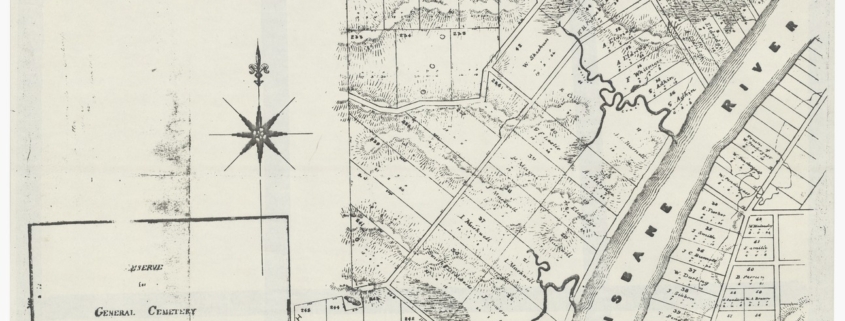
(1859). Plan of portions 203 to 257 in the environs of Brisbane, parish of Enoggera, County of Stanley, NSW. Surveyor General’s Office,
Here, perchance, the frail form of Innocence lies in peaceful security, and in close proximity to the housebreaker and man of blood. I give no fancy sketch here; the records of the past in this last sad resting place amply illustrates how Death levels all distinction when the spirit leaves its tenement of clay. Happily for this generation these records are all we at present possess, wherefrom to draw a moral, ‘or adorn a tale’. The presence of the felon and the debasing influence of a convict population has been spared us for many years past, and we trust our families may be long spared from those evils communications, that so rapidly corrupt the manners of a people. Yet, as we turn our horse’s head from the fence to proceed upon our journey a sadness comes o’er our spirits, as we contemplate that busy hive of human industry upon our right hand; because we know that at a cost of some £26,000 of the public money, they are there with building a Jail. Sad reflection to the philanthropist [sic][i], that the first public building erected in Moreton Bay should be a prison.
However, let us pass over this ridge and leave these sad moralising reflections behind us; at the foot of the ridge we cross the town boundary, and enter the suburbs, comprising the west, or aristocratic end of Moreton Bay’s embryo metropolitan city. At present, the western suburbs can boast but little of its architectural adornments, and unlike the eastern or down river suburbs, has not increased in a similar ratio the number of its inhabitants, yet it requires not the voice of prophecy to proclaim the future of this locality.
Passing to the side of the river we obtain a view of ‘Milton’, the town residence of J.F. McDougall, Esq., one of the Moreton Bay squattocracy, and who sets the laudable example of spending his income within the province wherein it is derived. The grounds about Milton, I may remark en passant, are being brought under judicious cultivation, and will very speedily form a very pleasant feature in our river scenery.
Crossing a small creek, by a very durable and creditable looking wooden bridge, we pass a quaint looking building in the course of erection, which might be very appropriately named ‘The House with the Three Gables,’ having a centre ornament overtopping all, looking for all the world like a miniature castle of Blue Beard’s, with a lookout turret for dear sister Anne. It is here that indefatigable old die-hard, Honest Bob Cribb, I understand, intends to pass the evening of his days; and from his look-out, take an occasional view of the progressive improvements of the land we live in.
Crossing a second bridge of similar construction as the first, we pass the modest cottage orneé of the Moreton Bay Stultz (Mr. John Markwell) and take a glance at the beautiful vista presented to view, up and down the three miles reach, the cleared lands on the south bank of the river showing at the present season to much advantage. A short distance beyond the second bridge, the road inclines to the right hand, skirting the back fences of a beautiful clearing known as ‘Lang Farm,’ and named after the worthy Doctor of that ilk. As my duties compel me to visit the various tenements and holding in my route to Moggill, let us have a gossip and a look round the nursery garden of friend Payne, the present occupier of the farm. To enable us to do so, we will let our horse nibble the grass in the outside paddock, and taking our course across the creek by the aid of the fallen tree, we enter the nursery through a magnificent grove of bananas, the pendant fruit issuing from which bespeak the richness of the soil from which their roots derive sustenance. In the open portion of the grounds some hundreds of orange grafts evidence the supply of those valuable and nutritious fruit trees, to be obtained here. The easy distance ‘Lang Farm’ is from the metropolis, places it in an excellent position for the inspection of visitors, should the Brisbane folk feel desirous of spending an idle hour in the inspection of this very pretty spot. As my duties impel me to proceed further along the river bank, I must leave a more detailed description of Payne’s nursery garden to some future visit; and take your readers with me through this bit of scrub—land bordering the Brisbane river; bearing in mind as you force your way through the pendant vines, or runners, interlacing and almost obstructing one’s progress in every direction, that great caution need be exercised to escape the tormenting fangs of the bush lawyer, a very formidable looking customer I assure you to come in contact with in passing through a piece of scrub land. To give your readers some faint idea of a scrub, let them conjure up in imagination a wood or forest in the old country, with the underwood left untouched; to which they may add any quantity of briers or thorns they may deem desirable to make the description perfect. I have often, in my young days, thought what a cunning old fox Robinson Crusoe was in planning the trees around his cave so thickly and impenetrably; but, I certainly think, the poor solitary would have gained a wrinkle, if he had dropped across a bush lawyer, to warn off trespassers; for I found out this much in passing through the same pilley, scrub, that this indigenous grab-all, like those gentlemen who in towns do congregate, have very little mercy upon those persons who foolishly place themselves within their clutches. In this respect, the passage of an Australian scrub strongly reminds me of the progress of a Chancery suit through the law courts. In either case the luckless wight that finally gets clear of the obstructions in the way, will find himself denuded of all superfluous toggery. What an immense variety of shrubs, creepers, and botanical specimens meet the eye in every direction; and the mind of the inquisitive is speedily filled with wonder and amazement at the bountiful productions of native wild. At last we reach a clearing; a spot of some half dozen acres from which the trees and brushwood have been but recently removed. In this patch we behold a splendid growth of early maize, the well cobbed stacks of which give the hard-working proprietor a sure token that his 30, or perhaps 50-acre farm, is amply worth all the labor he can bestow upon its clearing and cultivation. From 70 to 80 bushels to the acre may safely be set down as the produce of the crop, now almost ready for gathering. I found in this neighbourhood several other farms, recent purchases from the Crown, and like the one described, giving unmistakable evidence of what crops may be raised. From the scrub and forest lands bordering the rivers and creeks of this district, splendid potatoes, gigantic pumpkins, huge melons, and other vegetable productions, call up incessant observations for the uninitiated in these matters. However we will, for the present, leave our gossip upon the productiveness of East Moreton until a future paper, and in the meantime, resume our journey along the road to Moggill.
Like all the roads stretching away northerly from Brisbane, the one to Moggill is very hilly; and certainly but little adapted for wheeled vehicles, except the cumbrous bullock dray. But the river renders a ‘road’ in this direction at present almost unnecessary except for equestrians. About nine miles from town we reach ‘Pullen Pullen’ Creek, only navigable a short distance up for small boats. At the crossing place we arrive at the sheep station of Mr. John McGrath, who for some years past has done well, with a few sheep depasturing upon the country about the Pine Mountain Range. An immense quantity of fine pine timber has been procured from the scrubs, lying in dense masses at the foot of these picturesque mountains. Bullock teams convey the log to the ‘Creek’, from which place they are rafted and brought to Brisbane. The timber cut from this locality possess a harder and therefore more durable texture than the pine previously obtained in the low-lying scrubs on the riverbank. I am sorry to say, the paucity of building operations at present in progress in these districts have diminished the demand for all descriptions of building materials. The sawyers in this neighborhood, in common with other working hands, find some difficulty in clearing expect to see ‘a good time coming’.
Shortly after leaving McGrath’s the traveller begins to ascend a spur branching from the Pine Ranges towards the river; reaching the top of which, the admirer of the grand and beautiful will be amply repaid for his toilsome ascent. The view obtainable of the country lying to the eastward, and in the vicinity of these productive mountains, is very fine, whilst to the westward, their towering peaks, lifting their lofty heads in grand sublimity towards the clouds, mark the whereabouts of the splendid plains of Normandy, back up in the distance of the blue outline of the vast Australian Cordilleras; a couple of miles further brings us down upon Moggill Creek, and the cultivated farms of the residents in that quarter. The valley of the Brisbane in this direction does not embrace a very considerable tract of country, the land away from the river breaking off into rather poor ridgey forest upland; although the cultivators of the soil at Moggill have no reason, I understand, to complain of its fertility, very fair average crops of the usual Moreton Bay assortment of farm produce recompensing the exertions and outlay of the husbandmen. The Moggill districts have much to look forward to in the future reasonable progress of Moreton Bay. Its underlying stratum of Carboniferous formation, from which coal of a very excellent quality has been obtained in large quantities, and which, I believe, only re quires capital to develop their abundance and richness more fully, carries the mind of the speculator to that period when the steam traffic of this vast province will employ, and demand an enormous quantity of this description of fuel; for which the coal fields of Moggill and other localities will then reap a rich recompense. Moggill is further surrounded with mountains, clothed to their very summits with gigantic pine trees, thus possessing a mine of wealth below and above its surface. The removal of the 17 mile rocks, and other obstructions in the River Brisbane below Moggill, must necessarily add much to the importance of that locality; however, I will not pursue this interesting subject further, leaving the reader to make his own calculation in this ‘sketch,’ of what may be made out of the future as regards the progress of ‘Moggill.’
Before I finally quit this scene of rural industry let me make one observation, which I, for one, deem worthy of a passing remark. The first occupiers of the farms laid out by the Government Surveyor at Moggill, were immigrants brought out under the auspices of Dr. Lang; and, although only two or three families of that importation remain at present upon the original clearing, one memento yet stands upon the road side, that proves that the worthy Doctor’s selection of these people were not only creditable to himself, but reflect credit upon the land of their adoption. The memento I allude to is the erection, by these ‘Lima’ men, of a modest mansion, dedicated to the worship therein of the Almighty God. Yes! these travellers to distant lands felt, I have no doubt, when they sat down upon their several freeholds how much they were indebted to Him, for thus placing them in safety upon the seashores; and their first fitting acknowledgement of His goodness was, the voluntary erection of this house of prayer. Contrast this proceeding my dear readers, with that too often practised in other, and similar bush localities, instead of dedicating a house to the Father of all, we see them dedicating one to the father of evil, and therefrom supplying those liquid fires that burn out and obliterate all that is good here, and destroys every hope of the good promised hereafter.
A beautiful morning’s sunrise greeted the vision of those who, like myself, had to be up and doing in this battle of life early. How peacefully, how refreshed and refreshing, everything looked the eye rested upon. The dew drops flashed and sparkled as the gentle breeze waved the leaflets, and wafted up the aroma from the fragrant blossoms around. The cows as they quietly stood in the stock-yard, patiently waiting their turn to be released of their milky burthen[ii]; and for a few moments to be permitted to greet their young sucklings had, to my fancy, something of that mute eloquence poets often speak about, and which testifies a grateful heart.
A stroll down to the coal pit after breakfast, put me into possession of this fact, that the present supply of coal from the Moggill mine is not very extensive. The working seam (I found, upon making enquiry of a young lad who was using very striking efforts to induce an old horse to take his everlasting round at the mill crank, that put a force pump in motion) was at present nearly exhausted, only one man being then employed to get out coal for the steamers Hawk and Bremer. The entrance to the workings is by a cut made into the hill side. A shaft has I believe been sunk, but with what success as regard the finding of coal I did not hear; but lower down the Moggil Creek, I was informed a Mr. Lamsden had sunk a shaft to the depth of about 100 feet, and was very sanguine of dropping upon an extensive coal formation very speedily.
Quitting the farms and crossing the creek we came to a cluster of gunyahs occupied by the families of those men who are, and have been some time, employed in the timeless trade in this neighbourhood. I was pleased to find, that in several instances, these generally unprovided bush operators, had not knocked down all their hard won earnings at the grog shops in Brisbane; but wisely laid a portion of them out in the purchase of land, which I was further pleased to see was fenced in with good substantial three railed fences; and above all a comfortable looking house built upon each of these freeholds. May their example be followed by many of their fellow workmen, whenever their timber trade takes a turn for the better! Upon asking one of their numbers, who is amongst them known as Little Dick, how it was he had not, after so many years toiling, got a bit of land in his right, he made answer, ‘sure sir, if I haven’t bought any land, I have helped to build a good many houses.’ Very significant this, and certainly strengthens me in my previous opinion, that it will be the very opposite of a blessing should this neighbourhood reckon amongst its conveniences a Public House, or liquor store. A bush track made by the passing drays proceeding to and from the Pine Ranges, takes one through a very interesting region of hill and dale, the route being well marked by these dense scrubs fringing the steep acclivities of the mountains.
A ride of some five or six miles brought me to an extensive natural clearing, or opening in the hills, named by the timber-getters the paddock. A large quantity of valuable timber has within the last few years been cut from the scrub in that direction, and I found a number of men all busy falling and cross-cutting pine logs for market; the drays conveying them to Pullen Pullen Creek, and from thence they are rafted to Brisbane, where the steam saw-mills speedily convert them into boards and scantling for the home and foreign markets.
A large quantity of good agricultural land is to be found between the heads of the two creeks, (Pullen Pullen and Moggill), a portion in close proximity to the river, has been surveyed, and some portion purchased; but some excellent farms must someday be formed at the foot of these partially explored pine ranges.
My wanderings in the direction of Moggill being brought to a close at this point of my journey, in consequence of the service I had to perform being completed in that quarter, I must wind up my present ‘Sketch’ with again hoping, that in the perusal of my sketches of East Moreton, some pleasing information may be obtained by those who reside therein, and some profitable hints gathered by those who dwell in the land beyond the sea; and who feel the wants of a young and increasing family bear too heavily upon their resources, and look with great anxiety to the future provision of their households. To them I would conscientiously say, emigrate, and whilst you make the necessary inquiries that may rule your future movements, don’t forget to learn every particular about Moreton Bay—now speedily about to be made a separate colony, and ruled and governed by laws of its own construction.
[i]The spelling should be ‘philanthropist’, and is obviously a typographical error which slipped through the newspaper’s editing process.
[ii]According to Encarta Dictionary English (U.K.), ‘burthen’ is both a noun and a transitive verb. Its meaning is the same as the word ‘burden’.

