Martin Maguire

I have attempted to recall aspects of Toowong Hardware store owned and operated by my father, Alan Maguire, in the 1950s and early 1960s. After 50 years, my memory is far from clear. Apart from providing a snapshot of a Toowong business of yesteryear, I have presented an analysis of three important innovations during this time which have revolutionised the industry until this present time. I hope to prompt the memories of some of those who may have had dealings with or recollections of the store at that time. Those who remember ‘the way that it was’. With their input our understanding of the underpinnings of the present Toowong business precinct may be better understood.

My father was a metallurgist who worked in the steelworks in Port Kembla in NSW during the war years. After the war ended in 1945, he moved back to Brisbane with his new wife, Jean, and two young sons (Adrian and Martin). He took residence in the family home at Highgate Hill. There he worked in the air-conditioning industry, and then for the company which was the distributor of Kelvinator refrigerators. Within a year or two of shifting to Tarragindi in 1951, he made the  decision to go into partnership with my mother in his own business. By now three other children had joined the family (David, Helen and Judith).

From memory, my mother never took part in the actual hands on running of the business, so my (natural) understanding was that it was my father’s business. Only now while researching this account, did I notice that the photo of the sign outside of the Sherwood Road store was styled ‘AE & JE Maguire’s Toowong Hardware’. Forgive me then for using ‘he’ and ‘my father’ as the proprietor in the following account.

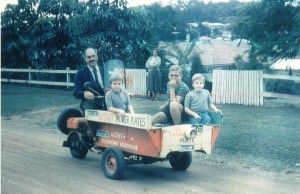
Toowong Hardware: Toowong Hardware was an existing business which came all stocked up and ready to run. It was operated by my father in three locations in Sherwood Road and Jephson Street, Toowong in the 1950s and early ’60s. Dad commuted each day to Toowong via Rocklea and Sherwood Road across the Walter Taylor Bridge. First of all he did this in his 1940s Wolseley 6 motor car and then later by his three-wheel Lambretta motor scooter, with a tray in the front to carry goods.

Lambretta colour

The Lambretta motor scooter with passengers

The original and largest store was located on the south-eastern corner of Sherwood Road and Jephson Street, hemmed in by a Shell Garage. The site was leased to him by the Shell Oil Company. When the lease expired and Shell took over the whole corner site, the business relocated to the opposite side of Sherwood Road to premises owned by a Mr Gittoes. Finally, as business declined further, Toowong Hardware moved to quite small leased premises in Jephson Street within the Jubilee Theatre building.

Eris Jolly’s aunt, Miss Dorothy Neal, came to Toowong in the 1930s to work for the Caldwell family who operated a hat factory.

Eris provided the following information about her aunt’s time of employment at the hat factory.

Dorothy_Eastaway_1938

Dorothy Eastaway (nee Neal) in 1938

My aunt, Dorothy Neal was born in 1904, and came to Brisbane with her parents and siblings from Blackbutt in 1920. They settled at Rode Road, Nundah. Dorothy was apprenticed as a milliner with the firm of Pettits in Fortitude Valley, Brisbane.

Dorothy later moved to Overells Department Store which was also in the Valley — though it may have been known as Whincups Department Store, as I know the family were friends of Mr and Mrs Whincup.

Dorothy’s father was appointed as the caretaker of the Orient Line building and as a comfortable residence on the top floor was provided for him and his family, in 1930 her parents, along with their two daughters, Dorothy and Joan, moved from Nundah to a flat on the seventh floor of the Orient Line building in Eagle Street, City. Dorothy sought to change her employment to a closer position and she moved to Toowong to work for Caldwell Millinery, where she stayed until she married Wiliam Eastaway in September, 1938.

Dorothy was the ‘Head Girl’ and was in charge of the factory. She travelled by train from Central Station every day to her place of work. Her husband, William Eastway, worked as a porter at Central Station.

J. Caldwell Hat Factory was located just outside the Toowong Railway Station in River Road, Toowong. The Caldwell’s residence was situated in Coronation Drive, between Booth Street and Paradise Avenue, next door to the Brisbane City Council sheds. It was on high stumps and looked over the river. Mr and Mrs Jas. Caldwell had two children, a girl named Elsie and a boy whose name I don’t recall, and who both died of lead poisoning in the early 1930s. I know that Elsie died in 1931.

Eris thought that this was why Mr and Mrs Caldwell grew so fond of her aunt and she said:

The death of the couple’s children from lead poisoning was very sad. They were young adults when they died, aged in their early twenties. They kind of adopted my aunt, who became very close to Mr and Mrs Caldwell, and they came to regard my aunt’s family as a substitute family. They were very good to my aunt.

I have a signet ring, with an ‘E’ on it, which my aunt gave it to me when I was a child. It belonged to Elsie and Mr and Mrs Caldwell gave it to my aunt when their daughter died. Because my name starts with an ‘E’, my aunt gave it to me.

Eris shared this special memory of Mr and Mrs Caldwell from when she was a child:

Mr Caldwell drove a car and on the occasional Sunday would drive Dorothy to visit my mother (who was her sister) and father and our family at Eagle Junction. My mother’s name was Rene and my father’s name was George Bond. My father worked for the Queensland railways. My mother was the eldest in her family of five girls and one boy. Cars were a novelty to us children as we certainly did not own one and sitting on the running board to have our photograph taken would have been the nearest we ever got to travelling in one.

Jolly, Eris_family_in_carThe accompanying photograph was taken in 1935 or early 1936; my Aunt Dorothy sitting in the driver’s seat; my mother, Rene in the passenger seat; her brother-in-law, George Bond (who was my father), leaning on the bonnet and Mr Caldwell (or ‘Jimmy’ as he was called) being the photographer. There were seven children in my family, one being born after this photograph was taken. My eldest brother must have scampered off to visit a mate the Sunday morning this was taken. I am the girl in the middle, sitting on the running board. The original of this photograph has been donated to the John Oxley Library.

Recently, while she was visiting the John Oxley Library, Eris had a half hour to spare, so she decided to consult the Post Office Directories to research the entries for Caldwell Millinery and for the Caldwell’s residence.

These are her findings:

In the Post Office Directory for 1934, commencing at the Regatta Hotel and going towards Toowong, the entries read (with the original spelling and punctuation as is): ‘Regatta Hotel; Robinson A. Mtr. garage & ser. Station; Paradise Ave.; Barr Alex.; Caldwell Jas.; City Council sheds; Dunn Ben J.; Henderson Mr. M.; Booth Street; Toowong Swimming Baths.; Railway Station.’

Then Eris checked the entry for the hat factory in the 1936 Post Office Directory for Sherwood Road, and it read: ‘Right from Railway Station: Toowong Post Office; Cmth Bank; Amor Hat Co., Hat mfrs.’

To Eris, this 1936 entry came as a complete surprise, so now she ponders several possible explanations. Did the death of their children cause the Caldwells to sell out to the Amor Hat Company, and continuing on as managers? Or did they decide to limit the liability of their business in the event of possible failure in these times of depression by restructuring the firm to create a company? If so, were they the only shareholders?

Whatever the circumstances were, Eris is definite that her aunt worked at a hat factory which was located next to the Railway Station and also that her aunt worked there at the factory for the Caldwell family until she married in 1938.

Consequently, Eris feels that further research is needed, whether in the trade directories, the phone books of the time and in the Post Office Directories, to answer these questions. She concluded her covering letter by saying, Maybe at some future time, when time permits, I will complete the research, for my own satisfaction.

Then the whole history of the Caldwell family and their millinery factory will be known!

Thank you to Eris Jolly for providing this contribution, written on 17 May 2008 and published in 2008 by the Toowong and District Historical Society in ‘Toowong: A Tram Ride from the Past’, p.24. To order see details on the Publications page.

Mrs Dorothy Beavis and her husband Kevin Beavis were interviewed by Leigh Chamberlain in November, 2000. Adopted as a child, Dorothy recalls the circumstances which led to her adoption. At that time it was legal for adoption to be privately arranged.

Dorothy_Beavis

Dorothy Beavis

Dorothy Beavis (née Harper) was born in 1931 and is the only child of Mr Ben and Mrs Alice Harper. Mr Harper, who was a returned serviceman from both the Boer War and WWI, worked for the Queensland Railways at Ipswich as a foreman coppersmith.

Dorothy lived with her family at 15 Sandford Street, which at that time was in Toowong. Dorothy recalls:

I have lived in the house for 69 years, and my dear beloved, [indicating Kevin], for 52 years. I was brought here as a baby, adopted by my parents who brought me here. I was only 2½ lbs when born and was ten weeks ‘premmie’ when my mother brought me down from Townsville on the train.

My real mum died when I was only five days old. Her name was Violet Ethel Drewett (née Harper). She was unconscious when she had me and didn’t even know that I had arrived. This is what I was told. My parents had me wrapped up in cotton wool and had newspapers around the bottom of a washing basket — you know, the old cane washing baskets. That’s how I came down from Townsville.

And I believe — it was really funny — there was one old busybody on the train, and she came up to Mum, and she said, ‘I had heard that Ben Harper had had a child but I didn’t believe it.’ No way I could have been Ben Harper’s child — he was the father who adopted me — but there was no way that I could have been his blood because we are altogether different. He was tall and as broad as anything, while I was a skinny little runt. My real father was a tall man too. His name was Edwin George Drewitt. As a matter of fact, I’ve got a brother who was over six feet tall.

Beavis1_6_tif

Poster advertising the Glen Olive Garden Estate

In 1924–25, Mr and Mrs Ben Harper had purchased a double allotment in a new development called ‘The Glen Olive Garden Estate’. They had a house built which they then rented out. After the Harpers returned from Townsville with their new ‘bundle of joy’, they were not able to live in their Sandford Street property because it was still tenanted. Therefore, they rented a house in Aston Street until their tenants were able to vacate. The Aston Street house was the one later purchased by Sir Arthur Fadden. So Dorothy was about six months old when the family finally moved into their Sandford Street house.

Dorothy wasn’t initially told that she was adopted, or that she had brothers and sisters. This important piece of information was disclosed to her much later, and contact with her real father was restored. There was a history of adoption in the family as Dorothy’s biological mother was herself adopted. Violet was adopted by Ben Harper’s parents, Mr and Mrs Ben and Elizabeth Harper, a stone mason who lived in Townsville.

Beavis1_8_house

Residence of Dorothy and Kevin Beavis in Sandford Street, Toowong. The tree at the back of the house is the last remaining olive tree from a grove which was planted in the area. (Photographer not known.)

According to the story handed down through the family, Violet’s mother was a servant girl who worked for the Harper family and when she became pregnant, the father abandoned her and her unborn child. Desperate for assistance, she turned to her employer, Mrs Harper, as she didn’t know what else to do. Although they already had two children of their own, Benjamin John and Louis Arthur Milton, they offered Violet’s mother a lifeline by deciding to adopt the baby. (The ‘Milton’ in Louis’ name was a family surname in the Harper family). When Violet died, her brother, Benjamin John, and his wife, Alice, decided to adopt Dorothy.

By adopting Dorothy when her mother died, the adoption was kept within the family. Alice Harper had a history of stillborn births, so the new-born baby gave Ben and Alice Harper a chance to enjoy parenthood that would have been denied them otherwise and she was their ‘only child’.

Dorothy had lots of extended family, both biological and adopted. Holiday time was a time for the extended family and Dorothy explains that when the family went to Scarborough:

…other children came with the family too. There were four kids, and Mum and Dad. Now, these other children that I’m talking about, who lived with me for years (I was thirteen at the time), were my brothers and sisters. I didn’t realise this at the time, as we were all brought up as cousins. This was only because my mother died while giving birth to me.

Thank you to Dorothy Beavis for the above reminiscences.

You can read more of Dorothy’s reminiscences in the Toowong and District Historical Society’s publication, Toowong: A Tram Ride from the Past, 2008, p.41. To order see details on the Publications page.

Roden_smlStuart Roden’s family came to settle in Toowong in about 1919 or 1920 when his father Olof Clarence (‘Clarrie’) Roden purchased land at 8 Augustus Street, three doors up from Bennett Street, and had the family residence built on this land.

Starting with memories of his childhood home, Stuart recalls nearby local streets and the people who lived here, and concludes at Toowong Memorial Park, the source of many wonderful childhood memories for Stuart.

According to McNaughts, our topside neighbours, the 1893 flood just reached the bottom side fence. Extensions were later added to the house. It was the place of birth for all three of us — Clarence James, who was known as ‘Jim’, born in 1921 Stuart (me), born in 1925 and my sister Eleanor Vera, born in 1926. Dr Wheeler, of Sherwood Road, delivered all three.Sherwood_Road

Originally, there was an ‘out-house’ dunny in the backyard. Augustus Street was one of the earlier streets in Brisbane to be connected to the main sewer to Pinkenba. The street was bituminised during the Great Depression by ‘Relief’ workers. The milkman, whose name was Mr Shields, delivered milk in big quart metal pots and pint pot. He had a utility truck covered at the back, with two big milk cans with taps on them and he’d fill our containers.

Delungra Street, off the north side of Augustus Street, was an easement which was lined with huge old gum trees on its eastern side and belonged to the Swain family who lived in a large old house down the easement. There was a white picket fence with double gates on Augustus Street. The hearse with the body of the grandfather of my friend, Wally Swain (full name: Walter Edward Swain) came out those gates, probably around 1937.

In Golding Street, that part of the street east of Earle Street was opened up in the mid-1930s with five look-a-like houses built on the north side. The area covered by the five houses and the extension of Golding Street was previously a big paddock which belonged to the Swain Senior family.

My friend Wally lived in a house on the eastern end of the old Golding Street, on the topside, with their northern fence on what was then a paddock. Cowboys and Indians and building cubby houses out of small trees in the paddock were what sometimes occupied my friend Wally and me. My mother took me to school (at the Toowong State School) on my first day and I was expected to find my way home. But Wally’s mother brought me home on the first day of school (along with Wally) from Toowong State School through their yard, the Swain Senior’s yard, the easement and the double gates on Augustus Street. Wally was a life-long friend until the day he died! He was my best friend at school and later I was his Best Man.

Next door, on the top side of Wally’s place, were the Fardons. Then there was a pedestrian lane here between Golding Street and Augustus Street. The lane is now closed. Then there were the Cribbs (he was a dentist); the Steers (and this house was later bought by the McGregor Lowndes) and then Charles Elliott, who was on the corner of Golding and Jephson Street. The latter was a stockbroker. On the right-hand side was the fire station, which I will discuss later. There was an easement from the lower end of the new part of Golding Street to Standring Street, which ran eastward to Bennett Street.

Church_St_Toowong

Church Street, now Jephson Street

Earle Street ran from Golding Street to Sylvan Road. Sylvan Road met Croydon Street at the corner with Church Street (now Jephson) and ran westwards to Milton Road. Just near the corner of Croydon Street on Milton Road was the Elite Picture Theatre where I used to go to the pictures with the family on Saturday nights. My father used to ring up and book our seats and we used to walk down and home again. Your eyes became accustomed to the dark and you didn’t really need a torch. You could see the Milky Way clearly in those days and it was beautiful to see!

Lands’ Wholesale/Retail Butcher Shop and Ice Works was on the corner of Earle Street and Sylvan Road. Augustus Street and Golding Street joined Jephson Street, formerly Church Street, as did Sylvan Road, which continued westward to Milton Road near the Brisbane General Cemetery (or Toowong Cemetery).

The Walker and Roberts families lived next door to each other in Sylvan Road, Toowong. Cecily Walker moved to here with her parents in 1929, while her cousin Erl Roberts and his family, didn’t come to live there until the 1940s. Erl was born about 15 years after Cecily.

When Erl and Cecily were interviewed in 2003, Erl provided the following memories of how his family celebrated Christmas during his childhood (from the mid-1940s to the early 1950s). Erl remembers:

I can remember the ice cream—people considered it a treat to obtain ice cream but there was no way of keeping it without freezers. We eventually bought a big flash refrigerator called a ‘Silent Night’. It had a freezer and then, of course, Mum could make ice cream. You could buy a cardboard cup of ice cream like Peters from the shop next door and take it home. You couldn’t buy chicken commercially like it is now. It was something you had at Christmas and Easter.

We used to go to Maroochydore. My grandparents on Mum’s side, the Smiths, had a little house they owned at Maroochydore and so Mum and Dad had the old Chev ‘ute’ (which we covered in at the back for holidays) and we’d take most of the baggage up there. We used to stop at Burpengary on the way up to have a cup of tea and a break.

We used to go up there every Christmas and every Easter with a couple of chickens on the running board—that was Christmas dinner! At the time, chicken was a luxury and you only had it at Christmas and Easter. [Cecily says: We all looked forward to that chicken twice a year.] The same with ice-cream — you only had it at Christmas and Easter. Mum used to make ice-cream, but prior to that, we used to buy it from the shop.

Elaine_Roberts_with_chooks

Elaine Roberts and the backyard chook pen

Dad used to kill the chooks, then we would pluck them, clean them—and those sort of things! Dad used to get young chicks and fatten them up for Christmas and Easter. Of course, I used to give them all names and got to love them all—nurse them and everything. And then the time would come! ‘You can’t kill Susie!’; ‘You can’t kill Betty’ and ‘You can’t kill Sebastian’. And he’d have to go and buy a chook! He spent all those months fattening them up and then he had to go and buy one! Uncle Dick used to buy the chickens from the Chinese market gardener down at Sylvan Road. You could buy ducklings from him and day-old-chicks.

An article featuring Erl Roberts and Cecily Walker’s memories of Toowong titled Cousins Share Memories of Toowong is published in Toowong: A Tram Ride from the Past, Memories of the Toowong Community Vol. 4, ed Leigh Chamberlain and Lindy Salter, Toowong and District Historical Society, 2008, p.14.

To order see details on the Publications page.

The name Toowong is thought to derive from the call of a bird, possibly the Koel, a parasitic species which lays its eggs in other birds’ nest in the area. According to Tom Petrie’s memories, the local indigenous peoples referred to the native bird, known as the black goatsucker (Eudynamis scolopacea), as tu-wong, an onomatopoeic word closely copying the sound of the bird’s call. Because the Koel lays its eggs in host nests in several tall eucalypts along the river bank on the bend of the Brisbane River below the Indooroopilly Bridge, the local indigenous peoples named this locality as Tu-wong. The name ‘goatsucker bird’ refers to an ancient name for nightjars, and these were misname.

The most likely species of nightjar in the Toowong area is the Whitethroated Nightjar Eurostopodus mystacalis. These used to be seen frequently on the hill in Toowong Park between the sports ground there and the basketball complex at Auchenflower. They were also seen along Toowong Creek; in the former Palmer’s Paddock (now the Queensland Academy for Science, Mathematics and Technology); and in the trees on the hills leading up to Mount Coot-tha, or, as it was formerly known, One Tree Hill.

Bird researcher Ian Venables explains:

Other early records say that Toowong was named after the koel. This is the recently renamed Eastern Koel Eudynamys orientalis, a member of the cuckoo family. They are migratory and arrive in the Toowong area each year in early September and all have departed for Papua New Guinea, Indonesia, other parts of SE Asia, the Solomon Islands, etc by early April.

This confusion would explain why newcomer to Toowong John O’Neil Brenan (who arrived in 1872) came to understand the origin of the word as the koel’s call (Eudynamis Flinderai, also known as the Flinder’s Cuckoo or the Koel Cuckoo). To this day, confusion still reigns as to the precise origin and meaning of the word for the suburb.

Venables concludes:

Aborigines knew both birds and had names for each. The nightjar may have been called one of the following names: Koongra, Minhlurlqlu, Yeearatta hear, Yeratta kuurk, or perhaps a name used only by the local people in this area. The koel may have been called: Aduric, Duwaw, Guwak, Minh-pult, Warkuli, Zow or perhaps a name used by the local people in this area. Some Aboriginal names for birds are onomatopoetic, but none of the above names closely resemble the call of either bird. Many names accepted as Aboriginal names in all manner of things were poorly translated by white settlers who often pronounced them quite differently from the way they were told them by the Aborigines.

The local creek had been called Toowong Creek, and is shown on survey maps as early as 1849. The word was later adopted as a locality name when local land owner Richard Langlar Drew advertised land for sale as ‘The Village of Toowong’. Between May 1862 and December 1863, Drew had purchased several blocks of land along Toowong Creek, stretching from Curlew Street (which in that time was entered off Moggill Road) to Darley Street in West Toowong, and subdivided these blocks for sale. Thus, the word ‘Toowong’ was used as a marketing tool. Today the Koel still nests along the creek (including today’s Oakman Park where Drew had established his home farm) and can be heard calling along its length during the summer.

The name ‘Toowong’ became more widely used when the Brisbane to Indooroopilly line opened on 14 June 1876 as an isolated line, with passengers being ferried across the river. The name ‘Toowong’ was given to the area’s newly-opened local railway station. By the time the railway line was built, the hamlet was showing signs of growing into a sizable village. Subsequently, the district’s inhabitants identified with the name of ‘Toowong’, and its inhabitants adopted the name ‘Toowong’ as a locality name after the railway station’s name.

Bibliography:
Helen Gregory, (ed.), Arcadian Simplicity J. B. Fewings Memoirs of Toowong, State Library Board of Queensland, Boolarong Publications, Qld, 1990.
Constance Campbell Petrie, Tom Petrie’s Reminiscences of Early Queensland, Angus and Robertson, London, 1983, p. 319.
Sun, 1 July 1917.
Ian Venables, The Naming of Toowong, unpublished research paper, 2010, TDHS files.
Leigh Chamberlain and Percy Hanlon, Toowong Crossing the Rail at Burns Road, Toowong and District Historical Society, 2010.