Badger’s house Arlington, Toowong Brisbane

Badger’s house Arlington; now known as Endrim

Address: 28 Woodstock Road, Toowong

Arlington was built in 1905 for American Joseph Stillman Badger. Badger named the house Arlington in honour of the United States National Cemetery. He became known as ‘Boss Badger’.

Badger, a qualified electrical engineer, came to Brisbane in 1896 at the age of forty-five on behalf of the General Electric Company as its chief engineer to oversee the electrification of Brisbane’s out-dated horse-drawn tram network for the Brisbane Tramways Company (BTC).

After the sudden resignation of BTC project manager, Mr Walklate, due to ill health in 1897, the BTC directors approached Badger to become not only BTCs Chief Engineer but also as to assume the duties of General Manager as well. Badger consequently resigned from GE. A proud American , Badger named the house Arlington in honour of the United States National Cemetery.

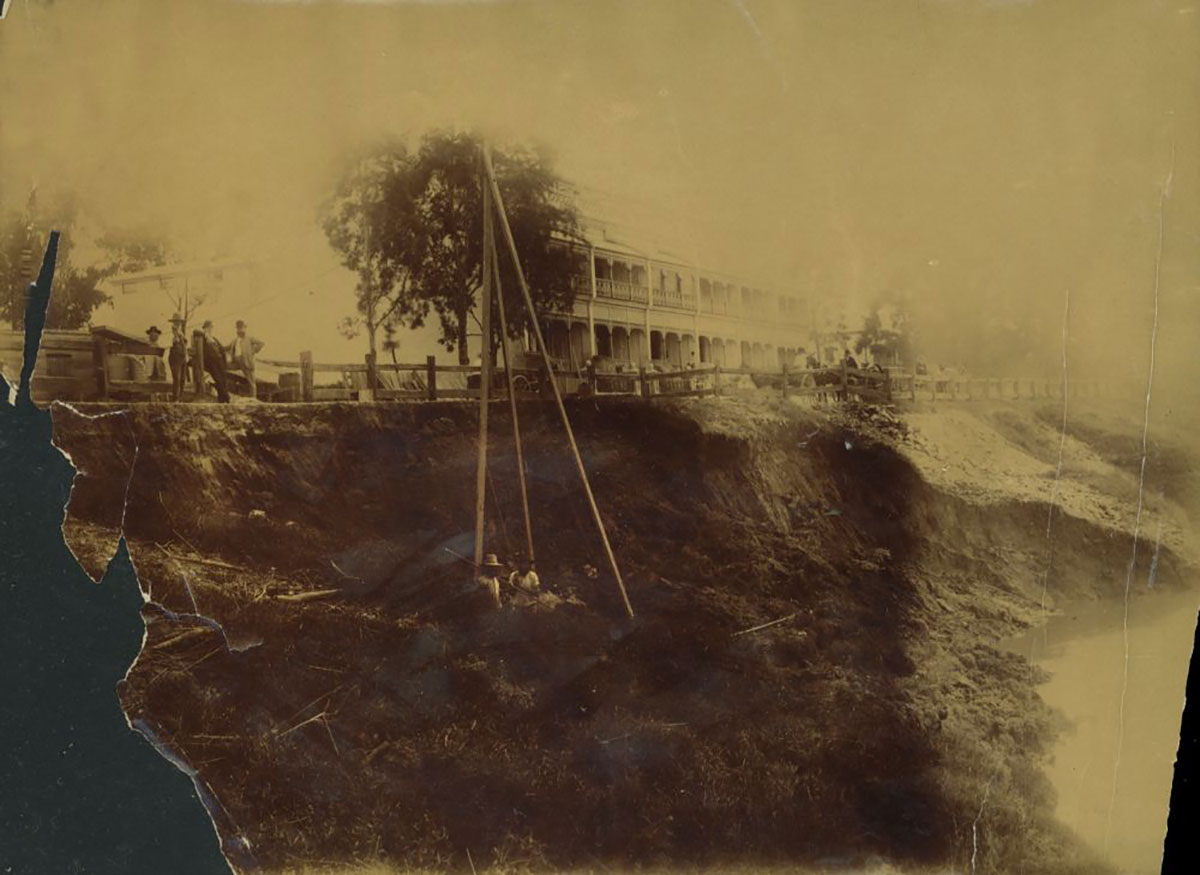
Arlington house in Toowong, 1906

Arlington, 1906 | Photographed by Frederick Munro Hull and courtesy of Genevieve Kennett [Toowong and District Historical Society Inc.]

Well-known local Toowong resident Percival Hanlon, who used to work at the BTC workshop prior to assuming the lease of the Toowong cross-river ferry, always maintained that the house sat upon tram tracks which were used as bearers. Speculation and rumour circulated Toowong as to whether this story was correct, so when the property eventually came up for sale many locals attended to check this out for themselves. As Hanlon’s son, also named Percival (‘Percy’), later related, ‘I went under the house and there it was!’

Verification that Badger had used tram tracks as bearers for his house did not dispel speculation, but instead added to it. As a result, particularly more recently, locals wondered whether he was using his position at the BTC to cream off monies from the Tramway Company for his advantage. Badger acquired a reputation which could be described in common parlance as being slightly ‘smelly’ and eyebrows were slightly raised at the notion of Badger’s integrity. The speculation resulted in an article being written a couple of years ago in the local newspaper Westside News which described Badger as being ’notorious’, which was the first time such speculation actually was recorded in print as being a fact (and without any supporting primary documents or evidence). Formerly, it was suggested in verbal asides only.

However, reminiscences collected by TDHS in 2003-05 from several elderly former residents, aged between their late 90s to over the age of 100, do not include a suggestion that Badger had a tainted reputation. These included the childhood memories of99 year-old Len Hall in 2003-4 whose parents operated the local shop in Woodstock Road across the road from Badger. So the speculation seemingly appears to be more recent in origin, gaining more credence since the decade 2000-10 when the earlier generation of residents had by this time died.

To further investigate these innuendoes, TDHS examined the title deeds for the property. One person keen to know the truth was Percy Hanlon who did the legwork. The information was passed onto Badger biographer David Burke (then researching for his book titled One American Too many Boss Badger and the Brisbane Trams). David kindly provided the information that the names on the title deeds were board members of the BTC.

This implies that Arlington was financed by the Brisbane Tramways Company, possibly as part of an executive salary package, but Badger appears to have had a free hand in the house’s design as the architecture has an American flavour. It would seem that more than half a century later speculation fueled by ignorance has sullied Badger’s reputation. But at the time the house was built, the fact that the BTC owned the house was well-known, and hence no eyebrows were raised at the mention of Badger’s name at that time. Otherwise, why would the upper echelons of Society so admire Badger, socialize with him, queue up to pay patronage to him and do business with him? Badger’s business acumen was admired far afield, not only in Brisbane, but also in Sydney, Melbourne, and Adelaide and also as far afield as in London and New York.

Prior to living at Arlington, by 1900 Badger and his family (who had joined him from America) lived at ‘Belle Vue’, a large house and property on the hill in Miskin Street, just short distance from where the construction of the tramline along Milton Road to terminate at the Brisbane General Cemetery was in progress. This tramline opened on 22 July 1904. Then Badger moved his family to ‘Arlington’. This was when work commenced upon the extension of the tramline from the gates of Brisbane General Cemetery, down Dean Street, and into Woodstock Road to terminate at the (Toowong) Tram Terminus situated just near his front gate. The Toowong Council had campaigned to extend the tramway down to terminate at Toowong, and there were plans to build more termini along Sherwood Road. But to protect its suburban railway traffic, the Railways Department made sure the track was kept apart from Toowong station and so the extended tramline and termini did not eventuate.

Badger used a gate built into his side fence to walk down concrete stairs built into the steep slope of the ridge to access the tram stop near to his residence where his private tram collected him to go into work. Claims published recently (in 2018) by The Courier-Mail that the Woodstock Road terminus is built upon Badger’s property are incorrect, as the terminus has been built behind the footpath at the base of the hill upon the publicly –owned Miskin Street road reserve.

Endrim House undercroft showing steel tram tracks.

Steel tram track floor bearers in the undercroft of ‘Endrim’ (2016).

A recent photo of the residence now known as ‘Endrim’ (2016). Photographs courtesy of Christopher Sapsford {Toowong and District Historical Society Inc.]


Badger was partial to moving. Between 1913-15, he moved again to Hargreaves Road, West End, and later elsewhere. He liked to move to an area where the tramway was being constructed so he was immediately upon the spot to supervise. Badger was very much hands on!

Due to both his role in the electrification and extension of the Brisbane tramway network and his hardline opposition to unionism and the role he played in the lead up to the General Strike of January 1912, the residence has ever since been associated with his name. However, people refer to it as Endrim, the name the property was later called, and not as Arlington.

Endrim has attracted more controversy lately with plans to build a childcare centre being lodged with the Brisbane City Council (BCC). Concerns have been expressed over a wide range of issues, with one being an expected increase in traffic and the another being the impact upon the heritage of the house.

References:

Leigh Chamberlain and Lindy Salter, Toowong; A tram ride from the past, Toowong and District Historical Society Inc., 2018, p.124.
Leigh Chamberlain, Interview with Len Hall, ca. 2003
David Burke, One American too many. Boss Badger and the Brisbane Trams, Queensland Museum, 2012.
Certificates of Title and survey plans, Museum of Lands, Mapping and Surveying
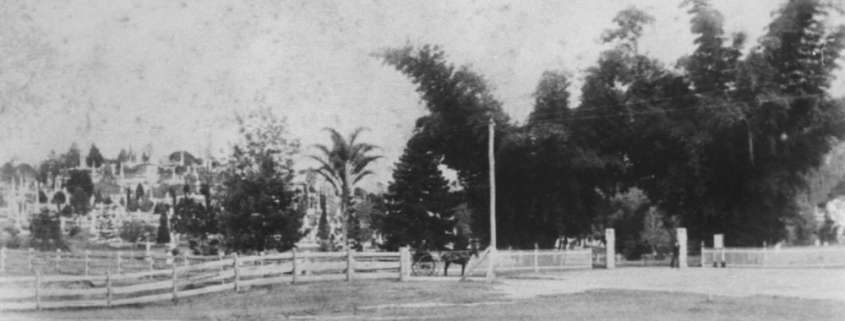
Brisbane General Cemetery ca 1889 courtesy SLQ

The Brisbane General Cemetery’s picturesque setting maintains the visual allusion of the Victorian concept of a mortuary park on the outskirts of the city. After a sizable portion of land was set aside for cemetery purposes at Toowong in 1861, the appropriateness of the site at Toowong for the purpose of a General Cemetery was an issue contested for the next two decades. It’s isolation and doubts about the suitability of its site, with a lack of access and public transport, fuelled dissent and debate while the public continued to use the cheaper, more accessible familial grounds at Paddington.

The State government passed the Cemetery Act in 1866 providing the means to establish general cemeteries under the control of government appointed trustees. In 1868, a further portion of Crown land, 53 acres in area, north of the cemetery reserve was added to fulfil of the Trustee’s requirement for the entire cemetery to be surrounded with public roads. The reserve was gazetted and the Cemetery Trust established in October 1870. The grounds at the Cemetery were laid out by the prominent surveyor, George Phillips and the Cemetery was officially opened on 5 July 1875.

The first burial here was that of Colonel Samuel Wensley Blackall (1 May 1809-2 January 1871), an Irish soldier and politician who served as Queensland’s second Governor. He served from 14 August 1868 until he died while in office. As his health was declining, in 1870, he selected the highest burial site at the new Toowong Cemetery. Shortly after, he died in office on 2 January 1871. His memorial is the largest and most prominent in the cemetery with commanding views of the city and surrounds.

Between Governor Blackall’s burial and the official opening of the Cemetery, there were six burials. The next interment was Ann Hill, wife of Walter Hill, superintendent of the Botanical Gardens on 2 November 1871. Thomas and Martha McCulloch were buried in November 1873, Teresa Maria Love on 16 March 1875 and Florence and Ethel Gordon on 4 July 1875.

The distinctive Cemetery gates are an example of the Victorian concept of a mortuary park and were designed by F.D.G. Stanley, who later resided in Church (now Jephson) Street, Toowong. The gates were erected in 1873-74.

For more information about the history of the Toowong Cemetery please visit Friends of the Toowong Cemetery.


Raymond Dart

Researched and written by Peter McNally

Raymond Dart (1893- 1988) was an anthropologist and palaeontologist who realized that a fossilized skull he was examining in 1924 was the earliest example of primordial bipedal man ever found to date, thus proving beyond doubt that human ancestors evolved out of Africa. Dart named the species Australopithecus africanus, the ‘southern ape from Africa’.

Robert Broom (a Scottish doctor who became a professional palaeontologist in 1933 at 67, and who was a long-time supporter of Dart) paid this tribute to Dart:

Raymond A. Dart’s discovery and analysis in 1924 was one of the most important in world history.

Early Years

Raymond Dart was born in Queensland, Australia in the inner western suburb of Brisbane on 4 February 1893. He almost didn’t make it as he, his mother, and her midwife had to be rowed to safety after he was born from the family grocery store in Sylvan Road, Toowong during one the Brisbane River floods of that year. He was the fifth born of nine children of Samuel Dart, a Queensland-born storekeeper, and his wife Eliza Ann, née Brimblecombe, who was born in New South Wales. He had seven brothers and a sister.

Despite being born in Toowong, Dart was raised mainly on a dairy farm near Laidley. His early education was at Toowong State School, which was then located in Aston Street, Toowong. He also attended Blenheim State and Ipswich Grammar schools. He later attended newly established The University of Queensland where he graduated with a Bachelor of Science on 17 April 1914 and a Master of Science, First Class Honours (in Biology), 10 May 1916. He later spent four years at the University of Sydney, studying medicine. All these qualifications were achieved before his 25th birthday.

After graduating, Dart left Australia and served in the medical corps as a captain and medic in the Australian Army in England and France during the last year of World War I. In 1920 Dart was appointed as a senior demonstrator at the University College, London at the direction of Grafton Elliot Smith. A famed anatomist and anthropologist, Smith was regarded as THE eminent anatomist in Britain. Interestingly, Grafton Elliot Smith, who was also a fellow Australian, had moved from Grafton (as in his name), New South Wales, to take up a position in London.

Dart then travelled to Washington University, St Louis, Missouri on a Rockefeller Foundation Fellowship, and then returned to his position at the University College, London,

In 1922, Dart left Britain to take up the position of Chair of Anatomy at South Africa’s newly established University of Witwatersrand’s fledgling Faculty of Medicine (sometimes called ‘Wit’s’ University). He was reluctant to do so, but agreed after encouragement from Elliot Smith and Scottish anatomist and anthropologist Sir Arthur Keith FRS, who was professor of physiology at the Royal Institution of Great Britain from 1918 to 1923 at the time. Dart was just 31 years of age.

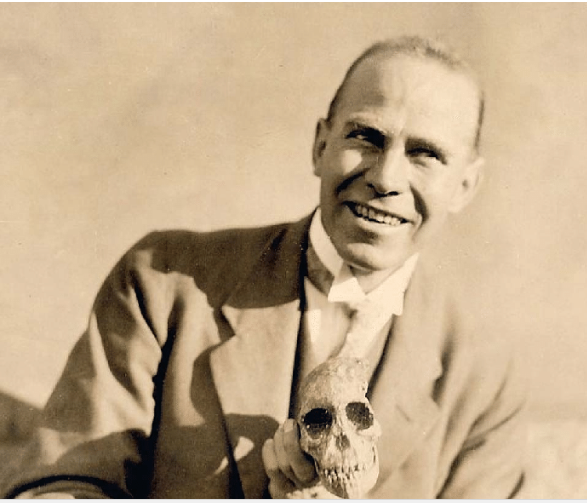
Raymond Dart

Archival photograph of Raymond Dart holding the Taung skull [Courtesy of WITS University Archives]

Taung Child

In 1924, one of Raymond’s students brought him some quarry rubble containing a skull. After Dart painstakingly cleared away non-essential debris around the skull, he declared : In my opinion it is not a young chimpanzee, as many scientists have suggested. I believe it is a crossover between an ape, and a human, possibly a human ancestor.

Raymond named his skull the ‘Taung Child’ after where it was discovered. Dart then presented his findings to the scientific journal Nature, who published his report on 7 February 1925.

Eventually, the skull turned out to be the earliest example of primordial, bipedal man ever found. It also proved beyond doubt that human ancestors evolved out of Africa.

Back in 1925 Raymond claimed that this genus of hominid would have had a posture and teeth similar to modern humans. It also had a small ape-sized brain. Most importantly, Dart, being an anatomist, knew that the position where the vertebrae entered the skull meant it was bipedal.

Dart’s conclusions were met with hostility from other many anthropologists. It must have been disappointing for Raymond to be challenged by Grafton Elliot Smith, his own professor and mentor, who stated, ‘The Taung skull was more likely to have been a chimpanzee, not a human ancestor’. After a number of years, a disenchanted Raymond gave up searching for fossils, and went back to teaching.

Piltdown Man

Dart had accepted the science of the time, that the earliest human ancestor was indicated by the discovery of Piltdown Man’s skull. It was found in 1912 by amateur archaeologist Charles Dawson in Pleistocene gravel beds near the town of Piltdown in Sussex, Britain, and was regarded as the earliest known record of a pre-human fossil. This proved that human ancestors evolved out of Europe. Grafton Elliot Smith, one of the anthropologists that Dart had observed and admired while working in London, was later called to the town of Piltdown to help reconstruct pieces of the skull that had been found there.

The Piltdown Man was later exposed to have been a hoax, one of the biggest frauds in anthropological science history. The general public were horrified to find out that the hoax had taken place, and even more concerning, that it took 31 years for the deception to be discovered. Today, after much investigation, the fraudster has not been named.

After witnessing the Dart experience following the discovery of the ‘Taung Child’, Robert Broom, a doctor and anthropologist, became interested in the search for human ancestors. He explored dolomite caves in South Africa, particularly Sterkfontein Cave (now part of the Cradle of Humankind World Heritage Site). Twelve years later, while continuing his exploratory digs, Robert Broom, found an adult female skull of the ‘Taung Child’s’ genus among other fossils in 1936.

Robert Broom’s discoveries of further Australopithecines (as well as Wilfrid Le Gros Clark’s support) eventually vindicated Dart, so much so that in 1947, Sir Arthur Keith, who had publicly disputed Raymond’s claims, in 1947 made the statement: ‘…I was wrong and Raymond Dart was right!’

Dart, who recalled that back in 1871 Charles Darwin had stated, ‘It was more probable than not, human ancestors evolved out of the African continent’, had the historical sense to remind the world of Darwin’s words. Thus Raymond Dart’s second distinction after realising the significance of the ‘Taung Child’, was that he had turned Darwin’s ‘Probable’ into a ‘Definite!’

Another major contribution by Dart was that he established Witwatersrand University as the epicentre of human evolution science, research and achievement. The Institute for the Study of Mankind in Africa was founded in his honour.

Others who have followed in his footsteps have been Professor Phillip V. Tobias, Dart’s long-time collaborator, successor and biographer. Tobias died in 2012 aged 86. Currently, Professor Lee Berger is a major contributor to ‘Wit’s’ research. In 2013, he and his large team discovered the biggest primitive hominin assemblage in history. Another is Professor Ron Clark, the man who found an almost complete skeleton of a 3.67 million year old human ancestor. It was named ‘Littlefoot’. Berger and Clark, as well as many others, are continuing the tradition of Raymond A. Dart’s work.

Raymond A. Dart died in South Africa on 22 November 1988, aged 95. This year 2018 commemorates 30 years since his passing.


Peter McNally, the author of this article, was born in Adelaide, South Australia in 1940. In 1975, Peter, his wife Judy, and their three sons moved to Queensland and over the past 25 years have lived in Brisbane, within 15 kilometres of where Raymond was born.

In recent years Peter has become very interested in researching the evolution of the Earth, and in particular, the evolutionary history of Australia, and human evolution within Australia. Peter further explains: ‘Australian’s evolutionary history goes back approximately 3.4 billion years ago to the Pilbara region of Western Australia. It’s one of the earliest places on earth where microscopic, biological, organism evidence has been discovered, making it one of the earliest places on earth, where life began.’

Thank you to Peter for sharing his research with the Toowong and District Historical Society Inc., and for giving permission for his article to be published.


References:

Encyclopaedia Britannica Volume 2, 1985, p. 436hNational Geographic, Volume 168, No. 5 November 1985.
Also the following webpages:
http://adb.anu.edu.au/biography/dart-raymond-arthur-12402
https://en.wikipedia.org/wiki/Missing_Link
https://en.wikipedia.org/wiki/Raymond_Dart
https://en.wikipedia.org/wiki/Raymond_Dart#cite_note-6
https://en.wikipedia.org/wiki/Taung_Child
https://www.britannica.com/biography/Raymond-A-Dart
http://www.talkorigins.org/faqs/homs/rdart.html
South African History online at http://www.sahistory.za   


Badger’s house Arlington, Toowong Brisbane

Introduction:

Toowong and its neighbouring suburbs feature many places of historical interest.

Some places are well-known to the wider community and are regarded as being iconic to the area. These include buildings such the two hotels, Regatta and Royal Exchange; churches such as St Thomas’s Anglican Church and St Ignatius Catholic Church; residences such as Warrawee, Moorlands, Milton House and Dovercourt; and businesses such as the Castlemaine XXXX Brewery and Peerless Dry Cleaners.

Significant places in Toowong aren’t necessarily always buildings and houses.  The divided road in High Street, now officially known as Patterson’s Folly, is in this category, as is the Crow’s Ash Tree on the corner of Sylvan Road and Milton Road.

There are others places less well known and these are hidden gems. These include Toby’s the Dog Postman’s Memorial and the Clock Tower in front of Toowong Village.

Other places can be described as localities or vicinities. In times past locals referred to the business area of Toowong as ‘The Village’—hence the origin of the name for the shopping centre now located in Sherwood Road. Other examples are Kayes Rocks and the bus turnaround in front of Toowong Village.

Yet other places have disappeared from the streetscape—some a long time ago and others more recently. These places may have disappeared but they still remain in the memory of those who still live here and also of those who used to live in the area. Sir Robert Philp’s former residence ‘Mallow’ is in this category—long gone due to fire, but still fondly remembered. Another is the Brisbane Cash and Carry (BCC), later bought out by Woolworths. Now Woolworths is also gone!

And who would forget Patterson’s Sawmill? Gone now for many, many years but still recalled nostalgically.

This article is the first segment of a series of articles about places of historical interest. Stay tuned as more articles will be added at a later date.

25/4/2018  


Part 1

Badger’s house: Arlington; now known as Endrim

Address: 28 Woodstock Road, Toowong

Arlington was built in 1905 for American Joseph Stillman Badger. Badger, the manager of the Brisbane Tramways Company, had been sent to Brisbane in 1896 as its chief engineer by the General Electric Company to oversee the electrification of Brisbane’s horse-drawn tram network, but left GE in 1897. A proud American, Badger named the house Arlington in honour of the United States National Cemetery.

Badger’s house Arlington, Toowong Brisbane

Badger’s house Arlington, Toowong Brisbane

The property was financed by the Brisbane Tramways Company, possibly as part of a salary package. Badger appears to have had a free hand in the design as the architecture has an American flavor. Rumours that the house was rumoured used steel tramway tracks as bearers has subsequently verified.

Badger moved to Arlington when work commenced upon the extension of the tramline from the gates of Brisbane General Cemetery, down Dean Street, and into Woodstock Road to terminate at the (Toowong) Tram Terminus situated just near his front gate. Badger used a gate built into his side fence to walk down concrete stairs built into the steep slope of the ridge to access the tram stop near to his residence where his private tram collected him to go into work.

Due to both his role in the electrification and extension of the Brisbane tramway network and his hardline opposition to unionism and the role he played in the lead up to the General Strike of January 1912, the residence has ever since been associated with his name. However, people refer to as Endrim, the name the property was later called, and not as Arlington.

References:

Leigh Chamberlain and Lindy Salter, Toowong; A tram ride from the past, Toowong and District Historical Society Inc., 2018, p.124.

David Burke, One American too many. Boss Badger and the Brisbane Trams, Queensland Museum, 2012.

Brisbane Boys’ College Rowing Shed

Address: Opposite the Regatta Hotel, Coronation Drive, Toowong

The Brisbane Boys College (BBC) boatshed was built on the river bank opposite the Regatta Hotel. After BBC relocated to Toowong from Clayfield in 1931, the school used the facilities of the Toowong Rowing Club. An application to build a new shed for the school was submitted to the Brisbane City Council (BCC). In response, the BCC closed off a public road located at the proposed site which allowed the application to proceed. Finance was raised through debentures offered to the Old Boys, from the college sports fund, and from the sale of the school’s former Breakfast Creek rowing shed. The use of Relief Labour during the depression years allowed the new rowing shed to be ready for use in September, 1933. After the 1974 flood in which the rowing sheds were destroyed the Toowong Rowing Club and the BBC rowing sheds were reconstructed next to The University of Queensland at St Lucia. The original ramps used to launch the shells at Toowong are still visible. GPS schools regattas were held on the Brisbane River up until 1973. After the 1974 flood a variety of venues have been used.

Brisbane Boys College Rowing Club c1947


Brisbane Boy College Rowers Carry Scull from Boathouse at Toowong, Brisbane, 1947 .
Brisbane John Oxley Library, State Library of Queensland

Reference:

Noel Quirke, Gentleman of Honour: A History of Brisbane Boys College 1902-2002, Brisbane Boys College, 2001.

Brisbane Cash and Carry, Toowong

Address: High Street, Toowong

The arrival of Brisbane Cash and Carry in 1923 changed the nature of how ordinary Australians did their weekly grocery shop and was the first Australian self-service grocery store. Claude Fraser and his wife, Gladys, travelled to America to investigate the advent of self service grocery stores. Customers embraced the concept.

On the 7th November, 1953, BCC Store Pty Ltd purchased a large block of land in High Street, Toowong, where a new branch of BCC was opened. William Land, butchers of Toowong provided meat to BCC. Kevin Cocks, son of Leslie Cocks whose family had operated Cocks grocery store across the road in Sherwood Road, attributes the closure of the 2-generation Cocks family-run business to the arrival of BCC in the Toowong shopping precinct. By 1965 the Cocks Family business had closed. BCC continued to trade here until early 1967. Later that year new owners, Guardian Assurance Co, Ltd. leased the property to Woolworths (Queensland Ltd) for 40 years. Woolworths continued to trade here despite changes in land ownership until January 2017.

Reference:

Webpage at https://australianfoodtimeline.com.au/brisbane-cash-and-carry/  extracted 2018.04.18.

Castlemaine Perkins Brewery

Address: Milton Road, Milton

The Castlemaine or Milton Brewery was established at Milton Brisbane in 1878 by Fitzgerald Quinlan and Co. The brothers Nicholas and Edward Fitzgerald had established brewing interests at Castlemaine in Victoria and then in Adelaide, Perth, Sydney and Newcastle. In Brisbane Quinlan Gray and Co had taken over interests of the Milton Distillery that was established on the site at Milton in 1870. The first brew by the new Milton Brewery was called Castlemaine XXX Sparkling Ale and was made to the same formula as the beer brewed by Castlemaine Brewery in Victoria.

Since medieval times when brewing was confined mainly to monasteries X, the sign of the cross, was a standard symbol of purity for alcoholic beverages. The number of X’s represented the strength of the beer. It was not until the early 1890s that the first trademark showing the 4Xs was applied for by the limited liability company Castlemaine Brewery and Quinlan Gray and Co.

Castlemaine Brewery at Milton Brisbane 1879

Castlemaine Brewery at Milton, Brisbane, 1879. John Oxley Library, State Library of Queensland

References:

History of the Castlemaine Perkins Brewery, 1877-1993, compiled by the Public Affairs Department, Castlemaine Perkins Limited Public Affairs Department, Milton, Qld, 1993.

Melva A Welch, Bergin Beauty. John Delaney Bergin Family, 2014, p.36.

Cook Terrace

Address: Corner of Park Road and 249 Coronation Drive, Milton.

JB Cook, who was a builder, applied to the Toowong Shire Council to build an hotel on the corner of Cribb Street and The River Road in 1887, but the Council rejected the proposal as it felt it was not necessary. There were two other hotels in the district. J B Cook then built Cook Terrace as his own residence after the application was rejected. Architects of the building were Taylor & Richer of 169 Queen Street, Brisbane. By 1922 Cook Terrace were also known as the Home Flats. Mr and Mrs Frederick and Ethel Laugher, brother and sister-in-law of the Misses Laugher after whom Laugher Park was named, leased a terrace house here c.1922-1929. By the early 1970s Cook Terrace had ceased to be a residential building and instead became commercial premises, which included restaurants. The property is a landmark in the district and is now heritage-listed.

River Road and Cook Terrace after 1893 floods, Toowong.

Subsidence along the River Road (Coronation Drive) after 1893 floods with Cook Terrace in background. 1893. Brisbane John Oxley Library, State Library of Queensland

References:

RHSQ Queensland History Journal, May 14 Vol 22, No.5, p396-7.

Leigh Chamberlain, The Laugher sisters of Toowong and their park, Toowong and District Historical Society, 2011.

Cross River Ferry

Address: across from the Regatta Hotel, Coronation Drive, Toowong

The ferries have existed since convict days and have been a vital transport facility for Brisbane. The first ferry in the district ran from Park Road Milton to South Brisbane commencing around 1914, and ceased in the 1940s. Percival Patrick Hanlon, the lessee, commenced the new Toowong–Hill End ferry service which operated from near the Regatta Hotel to Ferry Road, West End in 1922. It ran until1953. He first commenced operation using a row boat and then graduated to motor boats. An elderly Toowong resident recalls enjoying a ride across the river on the ferry for one penny. Various fares applied but “elephants were free’’. When Mr Hanlon became ill his wife Elizabeth Hanlon, nee Dale, obtained her Master’s license and ran the ferry during her husband’s illness but in 1953 Mr Hanlon was forced to retire from work. This ferry service continued until January 1974 when the Australia Day floods destroyed the jetty and pontoon.

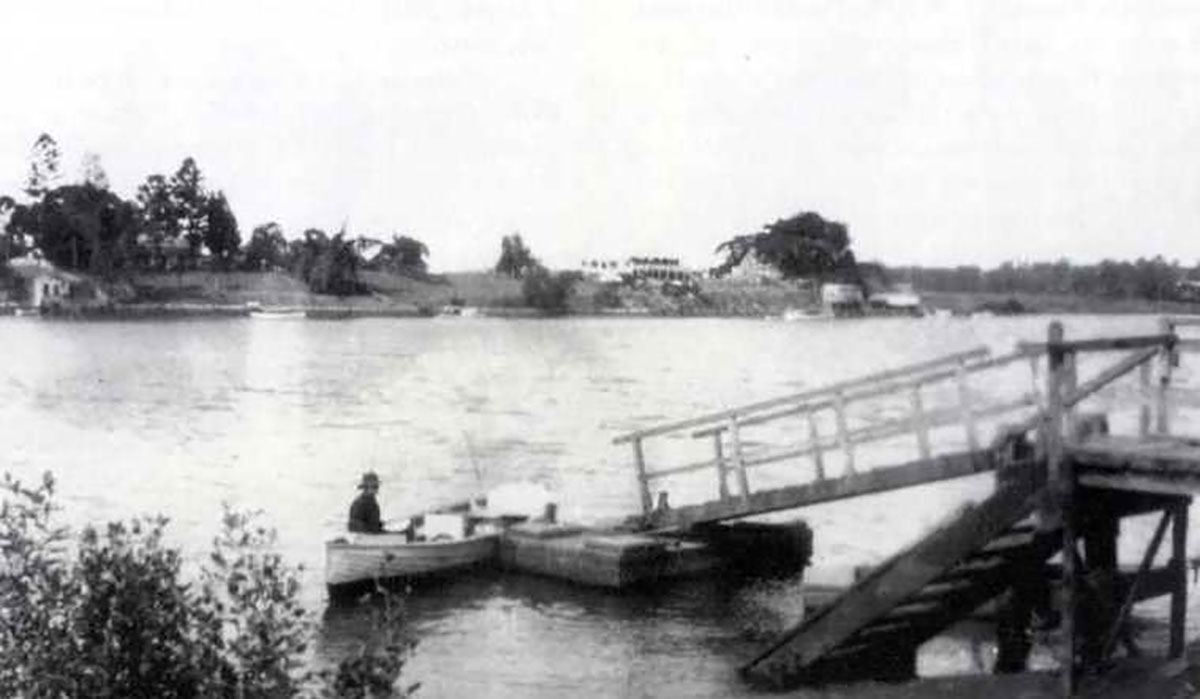
 Ferry - Toowong 1920's. Brisbane City Council (1920).

Ferry – Toowong 1920’s. Brisbane City Council (1920).

References:

John, Pearn, Auchenflower. The suburb and the name, 1997.

Percy Hanlon, ‘Oh-ver’: History of Brisbane Cross River Ferries, 2000.

Percy Hanlon,Memories of a Ferryman’s son’. p124 in Leigh Chamberlain and Lindy: Salter, Toowong. A tram ride from the past: Toowong and District Historical Society Inc., 2008